The Phoenix Lights : A MASS UFO SIGHTING THAT SHOOK THE WORLD IN 1997
- The Phoenix Lights : A Mass UFO Sighting That Shook the World in 1997.
*
**The Phoenix Lights: Unraveling the 1997 Mass UFO Sighting That Still Defies Explanation
**
A crisp, star-studded evening in the American Southwest, where the desert sky unfolds like a cosmic tapestry, unmarred by city haze. It’s March 13, 1997, in Phoenix, Arizona—a vibrant metropolis of over a million souls, cradled by rugged mountains and endless horizons. The Hale-Bopp comet, one of the most luminous in recorded history, is streaking across the heavens, drawing families, astronomers, and curious onlookers to backyards, rooftops, and open fields.
Telescopes gleam under the twilight; binoculars scan the void. But as dusk deepens, the comet becomes a mere sideshow. What emerges instead is a spectacle that will etch itself into UFO lore: the Phoenix Lights, a mass sighting witnessed by thousands, documented on film, and debated to this day.
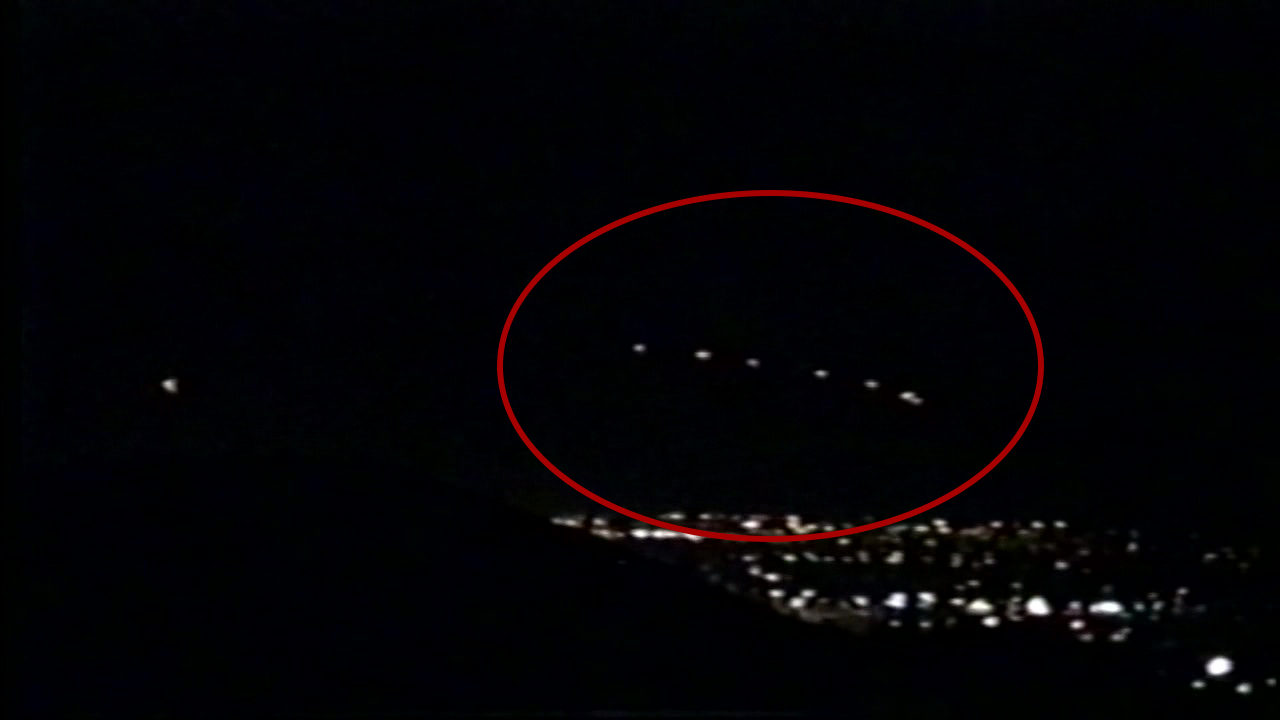
Let’s break it down chronologically, piecing together the eyewitness consensus with the precision of an investigation. The first whispers of anomaly hit around 7:55 PM in Henderson, Nevada, when a resident spots a colossal V-shaped array of lights—five to seven glowing amber orbs—gliding southeast without a sound. By 8:15 PM, the formation reaches northern Arizona, near Paulden and Prescott Valley.
Here, the Ley family—Tim, his wife Bobbi, son Hal, and grandson Damien—watches from 65 miles out as the lights morph from a distant arc into a precise, upside-down V, resembling a 60-degree carpenter’s square with orbs at the points. As it nears, they estimate it’s a mile wide, cruising at just 100 to 150 feet altitude, slow as 30 to 40 mph, and utterly silent—no engine hum, no rotor chop. “It blocked out the stars,” Tim Ley later recounts, suggesting a solid, dark structure linking the lights, like the belly of an immense craft slicing through the night.
By 8:00 PM, the phenomenon sweeps into Phoenix proper, hovering low over suburbs like Glendale and Scottsdale. Witnesses describe a boomerang or triangular silhouette, spanning several football fields, moving deliberately southward. No sonic boom, no turbulence—just eerie quiet.
Truck driver Bill Greiner pulls over on Interstate 10, transfixed: “It wasn’t planes; planes don’t move like that, hovering and silent.” In Chandler, Mike Fortson and his wife stare from their backyard as the V drifts directly overhead at what feels like 500 feet.
“Enormous, like a floating city,” Fortson insists, “and not a whisper of noise.”
Even actor Kurt Russell, piloting his son Oliver into Phoenix Sky Harbor Airport, radios air traffic control: “Six lights over the airport in uniform V-shape—very strange.” From 30,000 feet, a commercial airline pilot echoes the sentiment: “Unlike any aircraft I’ve flown.”
This isn’t isolated hysteria; estimates peg 10,000 to 20,000 witnesses across 300 miles, from Nevada to Tucson. In this pre-iPhone age, people scramble for camcorders and cameras. Among them: Dr. Lynne Kitei, a prominent Phoenix physician and self-described skeptic. From her Paradise Valley home overlooking the city, she films one of the clearest records—a line of orbs pulsing in unison, appearing and vanishing sequentially.
“This defies logical explanation,” Kitei later states in her book, The Phoenix Lights: A Skeptic’s Discovery That We Are Not Alone. Her footage, analyzed by experts, shows no smoke trails, no erratic flicker—just steady, synchronized lights maintaining formation.
Kitei interviews hundreds: astronomers ruling out stars or planets, pilots debunking conventional aircraft, military vets dismissing flares. The consensus? A massive, structured object, not of human origin—silent, low-flying, star-obscuring, and maneuverable in ways defying physics.
But wait—there’s a second phase around 9:30 to 10:30 PM, often conflated but distinct. Over the Estrella Mountains southwest of Phoenix, a row of stationary lights hovers, then winks out one by one. Kitei’s video captures this too, but witnesses like her argue it’s separate from the earlier V-formation flyover.
Phone lines erupt: Local news, police, Luke Air Force Base field hundreds of calls. The air crackles with awe and unease—families cluster, strangers bond over the spectacle.
Morning breaks, and Phoenix buzzes. Stations like KPNX air frantic interviews; national outlets—CNN, USA Today—amplify the story globally. A Scottsdale teen group’s home video captures excited chatter: “It’s huge—what is that?” Yet official silence reigns initially.
Weeks later, the Air Force pipes up: The lights? Just LUU-2B/B illumination flares dropped by A-10 Warthogs during routine training at the Barry M. Goldwater Range, 60 miles southwest. Released around 10:00 PM, they claim wind and distance created illusions of connection.
Witnesses fire back. The timeline doesn’t align—the V-formation hit hours earlier, at low altitude, moving north-to-south. Flares parachute down, trailing smoke, flickering wildly; these were steady, smokeless, unified. Recreations flop: No flare demo matches the scale or silence.
“I’ve seen flares in combat,” a veteran scoffs. “This was no flare.” Skeptics like astronomer James McGaha counter its simplest explanation is that it was merely A-10 jets in formation for the first event, flares for the second.
However, Kitei’s analyses and witness polygraphs push back: The object occluded stars, implying solidity, not dispersed lights.
The gaslighting peaks in June 1997. Governor Fife Symington stages a press circus, parading his chief of staff in an alien costume: “You guys are too serious.” Laughter from the podium; outrage from the public. It backfires, stoking cover-up theories.
Symington’s own fall from grace—indicted for fraud in September 1997 (later overturned)—frees him. In 2007, he confesses on CNN: He witnessed it too. “Enormous, delta-shaped, otherworldly. Not of this world.” Why the mockery? “To calm hysteria,” he claims, but now urges transparency: “The government knows more.”
Kitei emerges as the investigative linchpin, her documentary The Phoenix Lights… We Are Not Alone winning awards, her book dissecting evidence. Thanks to her, the event fuels UFO research, inspiring films like The Phoenix Incident and annual vigils. It shifts paradigms: UFOs—now UAPs—enter mainstream, foreshadowing Pentagon task forces.
Nearly three decades on, no sighting rivals it—thousands eyeing a mile-wide enigma over a major city. Why the drought? Cloaking tech? Phenomena evolution? In our smartphone era, it’d go viral instantly, demanding answers. But would officials admit the truth, or cling to flares?
The Phoenix Lights challenge us: Extraterrestrial probes? Black-ops tech? Inter-dimensional visitors? One truth endures—they force us to question reality.